The world’s first dual-fuel container ship with a capacity of 24,000 containers
OOCL Wisdom – the world’s first dual-fuel methanol container ship with a capacity of over 24,000 containers – has officially completed sea trials, marking a major step forward for the global green shipping industry. Designed and built by China, the ship is expected to contribute to the reduction of carbon emissions in the international shipping sector.
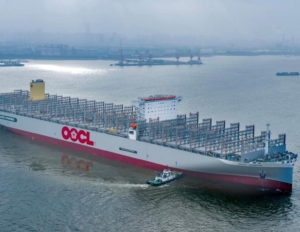
The World’s First Methanol-Powered Container Ship Begins Sea Trials
According to Xinhua, the world’s first dual-fuel methanol-powered container ship has departed from Nantong, Jiangsu Province, to begin sea trials. Upon completing its technical and operational testing, the vessel will be deployed on international shipping routes.
Named OOCL Wisdom, the new vessel was built by Nantong COSCO KHI Ship Engineering. It has a deadweight of 225,000 tonnes and can carry up to 24,168 twenty-foot equivalent units (TEUs), making it one of the largest container ships ever built.
Impressive Specifications of the Dual-Fuel OOCL Wisdom
OOCL Wisdom ranks among the world’s largest container ships, featuring:
- Length: 399.99 meters
- Beam (Width): 61.3 meters
- Height: 33.2 meters
- Maximum Capacity: 24,168 TEUs
- Deadweight: 225,000 tonnes
The vessel is also one of the most technologically advanced container ships, equipped with cutting-edge green shipping technologies.
Dual-Fuel Methanol Technology Significantly Reduces Emissions
According to representatives from Nantong COSCO KHI Ship Engineering, the ship’s greatest technological breakthrough is its world’s largest dual-fuel methanol main engine.
OOCL Wisdom is equipped with:
- A dual-fuel methanol main engine
- A modern boiler system
- Auxiliary engines with flexible fuel-switching capability
This system allows the vessel to seamlessly switch between methanol and conventional marine fuel during operation.
When powered by green methanol, the ship can:
- Reduce approximately 150,000 tonnes of CO₂ emissions per year
- Produce virtually zero sulfur oxide (SOx) emissions
- Significantly reduce nitrogen oxide (NOx) emissions
These environmental benefits position OOCL Wisdom as a new symbol of the global transition toward low-carbon maritime transport.
China Accelerates the Development of Green Shipbuilding
According to China’s Ministry of Industry and Information Technology (MIIT), the country’s shipbuilding output reached 15.68 million deadweight tonnes in the first quarter of this year, representing a 46% increase compared to the same period last year.
Notably, green vessels accounted for 80.2% of newly secured international shipbuilding orders during the period.
Industry experts believe this trend reflects China’s long-term strategy to strengthen its environmentally friendly shipbuilding industry.
The clean energy sources currently receiving the most attention include:
- Methanol
- Liquefied Natural Gas (LNG)
- Electricity
- Ammonia
Global Shipping Faces Growing Pressure to Decarbonize
The international shipping industry is under increasing pressure to reduce greenhouse gas emissions and accelerate its green transition.
According to Interesting Engineering, the International Maritime Organization (IMO) aims for the global shipping industry to achieve net-zero greenhouse gas emissions by around 2050.
As a result, shipping companies and shipbuilders worldwide are accelerating technological innovation, developing vessels powered by cleaner fuels, and improving operational efficiency.
Methanol-Powered Ships Signal a New Era of Sustainable Shipping
The launch of OOCL Wisdom represents not only a significant technological milestone for China’s shipbuilding industry but also highlights the accelerating transformation of the global maritime sector.
As environmental regulations become increasingly stringent, dual-fuel methanol-powered vessels are emerging as a key solution for reducing emissions, improving fuel efficiency, and supporting the shipping industry’s long-term sustainability goals.