The maritime industry needs breakthrough mechanisms to expand its reach into the open sea.
Vietnam’s maritime industry is experiencing positive developments, thanks to increased investment in port systems, logistics, and marine economic infrastructure. However, to realize the goal of sustainable marine economic development by 2030 and the vision to 2045, the maritime industry needs breakthrough mechanisms to remove institutional bottlenecks, planning issues, and infrastructure connectivity.
From Port Investment to a Comprehensive Vision for Marine Spatial Development
More than seven years after the implementation of Resolution No. 36-NQ/TW on Vietnam’s Strategy for the Sustainable Development of the Marine Economy, the country’s maritime sector has undergone significant transformation—not only in terms of infrastructure investment but also in its overall development philosophy.
While maritime development previously focused primarily on individual port projects or standalone shipping routes, the current approach emphasizes integrated, multi-purpose, and sustainable marine spatial planning.
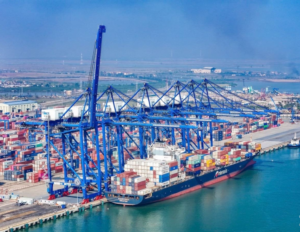
According to the Vietnam Maritime Corporation (VIMC), investment is increasingly concentrated on international gateway ports, transshipment hubs, and logistics ecosystems in key economic regions to improve operational efficiency and strengthen Vietnam’s global competitiveness.
Strategic Port Projects Continue to Advance
Several major maritime infrastructure projects are currently under development, including:
- Container Terminals No. 3 and No. 4 at Lach Huyen International Gateway Port, Hai Phong
- Can Gio International Transshipment Port
- Lien Chieu Port
- A nationwide network of inland container depots (ICDs) and large-scale logistics centers
These projects serve not only as transportation infrastructure but also as critical components of coastal industrial and logistics value chains, helping establish new growth poles for Vietnam’s marine economy. The maritime industry needs a breakthrough mechanism.
During the 2020–2025 period, VIMC handled an average of more than 21 million tonnes of seaborne cargo annually, while cargo throughput across its port system exceeded 130 million tonnes per year, recording an average annual growth rate of nearly 8%.
Digital and Green Transformation Become Essential Priorities
Alongside infrastructure expansion, Vietnam’s maritime industry is accelerating digital transformation to improve operational efficiency and management.
Modern technologies being deployed include:
- Terminal Operating Systems (TOS)
- E-Port platforms
- Smart Gate systems
- Centralized data management centers
These digital solutions help reduce cargo dwell time, streamline port operations, and enhance logistics service quality.
At the same time, green transformation has become a long-term strategic priority. VIMC is implementing green port initiatives across its network by electrifying port equipment, expanding the use of solar energy, and deploying environmental monitoring technologies to reduce greenhouse gas emissions in line with international standards. The maritime industry needs a breakthrough mechanism.
Marine Spatial Planning Remains the Biggest Challenge
Despite notable progress, Vietnam’s marine economic development continues to face significant obstacles.
One of the most pressing issues is the slow implementation of the National Marine Spatial Plan at the local level, resulting in overlapping claims and competing uses of marine resources.
Key sectors—including:
- Maritime transport
- Fisheries
- Offshore wind power
- Oil and gas
- Marine tourism
- Marine conservation
are increasingly competing for limited marine space, creating challenges for long-term investment planning.
In addition, procedures for obtaining marine area use rights, defining maritime boundaries, and completing investment approvals remain time-consuming due to fragmented data systems and administrative complexities.
Stronger Policy Reforms Are Needed
Industry experts believe that Vietnam’s maritime sector requires stronger policy mechanisms to overcome existing bottlenecks.
Key recommendations include:
- Improving the legal framework for the marine economy
- Better integrating marine spatial planning between central and local governments
- Eliminating overlaps among the Maritime Code, Land Law, and Investment Law
- Establishing an inter-agency coordination mechanism for marine space management
- Prioritizing land and water resources for strategic maritime infrastructure
- Accelerating the development of transport links connecting ports and logistics networks
These reforms are expected to lay a stronger foundation for the sustainable growth of Vietnam’s maritime industry.
Shipbuilding Is a Strategic Pillar of the Marine Economy
According to industry experts, achieving a truly competitive marine economy requires Vietnam to develop a comprehensive maritime industrial ecosystem rather than focusing solely on ports and logistics.
Within this ecosystem, the shipbuilding industry plays a critical role by supporting:
- National shipping capacity
- Supporting industries
- Maritime supply chains
- Logistics self-sufficiency
Many experts have called for a long-term national shipbuilding strategy alongside the development of integrated shipbuilding–logistics–port clusters to enhance Vietnam’s competitiveness in the global maritime market.
A Breakthrough Framework Is Essential to Unlock Vietnam’s Maritime Potential
As the marine economy is increasingly recognized as one of Vietnam’s key engines of economic growth, the maritime sector is presented with unprecedented opportunities for expansion.
However, fully realizing this potential will require faster policy reforms, improved marine spatial planning, stronger infrastructure connectivity, and the development of a modern shipbuilding industry.
Only by building an integrated ecosystem that combines maritime transport, logistics, ports, and marine industries can Vietnam achieve its long-term ambition of becoming a strong maritime nation and creating sustainable prosperity from the sea.